
Buying a hot tub is one of those decisions where the difference between a great experience and an expensive regret comes down to about a dozen questions most buyers don't know to ask. We've watched thousands of purchases play out — the happy owners and the frustrated ones — and the pattern is consistent.
Here are the 11 things to know before you put any money down in 2026. Read them in order; each one builds on the last.
1. Decide Your Real Budget — Then Add 15%
The single most common buyer regret isn't picking the wrong brand. It's underestimating the all-in cost.
A hot tub's sticker price is roughly 85% of the out-the-door cost. The other 15% is:
- Delivery and placement ($300–$800)
- Electrical install ($800–$2,500 for 220V; $0 for 110V)
- Site prep (gravel pad $150 / concrete pad $1,500+)
- Cover lifter, steps, water care startup kit ($400–$700)
A $9,000 tub becomes a $10,500 tub by the time it's running. Plan for it now or stretch your budget later.
For a realistic look at what people actually paid in 2026, see our hot tub prices article.
2. Count Jets — But Count Them Right
"How many jets?" is the most-asked question by buyers and the most-misleading number on a spec sheet. A 100-jet tub isn't necessarily better than a 40-jet tub.
What matters:
- Jet placement. Are they hitting the muscle groups you want? Lower back, neck, calves?
- Jet variety. Rotary, directional, pulsing — each does a different thing.
- Pump capacity per jet. 80 jets on one weak pump is worse than 40 jets on a strong one.
Rule of thumb: 20–30 well-placed jets on a strong pump beats 60+ underpowered ones every time. Ask the dealer for the GPM (gallons per minute) per pump, and how that divides across the jets. If they can't answer, move on.
3. Insulation Is the Whole Game
We rank every hot tub on a 1–3 insulation scale:
| Rating | Type | What it means |
|---|---|---|
| 1 | Blanket/perimeter only | Cheapest. 110V tubs and budget 220V. Highest energy bills. |
| 2 | Partial-foam | Some foam over equipment + walls. Mid-range standard. |
| 3 | Full-foam (high-density) | Foam fills the entire cabinet cavity. Premium tubs only. |
In a cold climate, the difference between a 1 and a 3 is $300–$500 per year in electricity — about $4,000 over a 10-year ownership. That's bigger than most buyers' discount negotiations.
We have a full insulation methods deep dive if you want to go further. For most buyers: if you live north of the Mason-Dixon, full-foam is non-negotiable.
4. 110V vs 220V: Pick Based on Use, Not Convenience
110V (plug-and-play) tubs run on a standard outlet. No electrician. Lower install cost. Lower upfront price.
220V (hardwired) tubs need a dedicated circuit installed by an electrician. Higher install cost. But:
- Heater runs simultaneously with jets (no temperature drop during use)
- Faster heat recovery
- More jet horsepower available
- Required for any tub over ~5 people
The honest math: a 110V tub makes sense if you'll use it occasionally, in mild weather, with 1–2 people. Anything more serious — get 220V. The $1,200 electrician cost pays back in performance you'll feel every soak.
5. Seating: Loungers Are Polarizing
A "lounger" — the recliner-style horizontal seat — sounds great in the showroom. In practice, about 40% of owners love them and 40% never use them after year one.
Loungers work for you if:
- You're 5'8"–6'2" (most loungers are designed for this range)
- Your primary use is solo therapeutic soaking
- You don't mind giving up a seat for it
Loungers don't work if:
- You're shorter than 5'7" (you'll float out)
- You're taller than 6'3" (you won't fit)
- You bought the tub for socializing
A 6-seat tub with a lounger really seats 5 socially. Factor that in.
6. Shell Construction: The 20-Year Question
There are three real shell types:
| Type | Lifespan | Cost premium |
|---|---|---|
| Roto-molded plastic | 8–12 years | Baseline |
| Thermoformed acrylic | 12–18 years | +$500–$1,000 |
| Cast acrylic with ABS backing | 20–30+ years | +$1,500–$3,000 |
Cast acrylic with ABS backing is the gold standard. It's what every reputable luxury and premium mid-range tub uses. The shell will outlast everything else in the tub.
If the dealer can't tell you the shell construction, that's the answer.
7. Warranty: Read the Document, Not the Ad
"Lifetime warranty" appears on a lot of brochures. What it actually means varies wildly. Ask for the actual warranty document and look for four things:
- Shell structure vs shell surface — these are usually warrantied separately, and surface is much shorter
- Plumbing and pumps — typically 2–5 years
- Electronics — typically 1–3 years
- Labor coverage — is the dealer's labor included, or do you pay $150/hr for repairs?
A "lifetime" structure warranty with a 90-day surface warranty and no labor coverage is essentially a one-year warranty. Premium brands like Hot Spring, Caldera, and Jacuzzi typically cover labor for 5+ years.
8. Delivery and Site Prep: Plan This First, Not Last
We see two delivery-day disasters every week:
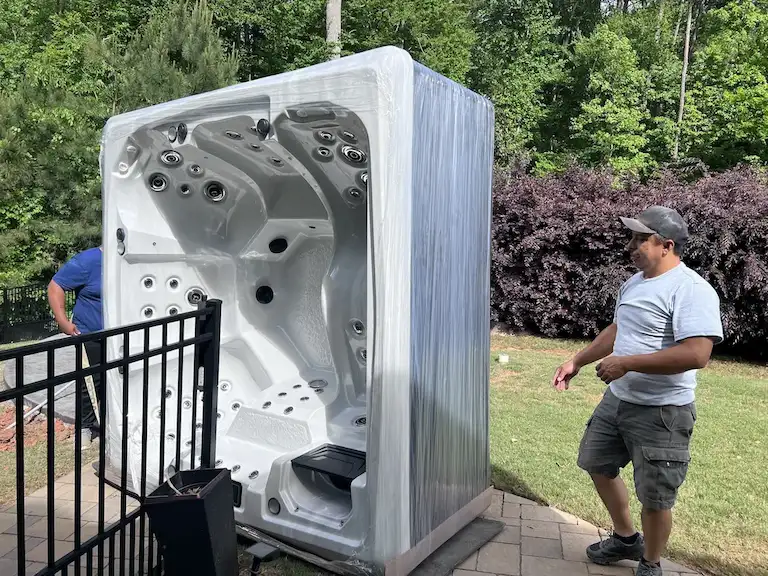
- The tub doesn't fit through the gate. Measure the narrowest access point. Most full-size tubs need 42"+ of clearance on edge.
- The pad isn't ready or isn't strong enough. A full hot tub with six adults weighs 4,000–6,000 lbs. Wood decks need engineering verification. Pavers shift. Concrete or a properly built gravel pad is the standard.
Talk to the dealer about delivery requirements before you sign. A reputable dealer will do a site visit for free.
9. Water Care: Pick Your Chemistry Before the Tub
Three options:
- Chlorine — cheapest, easiest, what 90% of owners use. Slight smell, fine for most people.
- Bromine — gentler on skin, more stable at high temps. Slightly more expensive. Common for sensitive-skin owners.
- Saltwater — the salt-cell system generates chlorine from salt. Smoother water feel, less chemical handling. $1,000–$1,800 premium and only worth it on premium tubs with OEM salt systems.
Read our chlorine vs bromine breakdown and saltwater explainer before committing.
Whichever you choose, budget $150–$300/year for chemicals.
10. Dealer Selection: This Matters More Than Brand
We mean this seriously: a B+ brand with an A+ local dealer will give you a better 10-year ownership experience than an A+ brand with a mediocre dealer.
The hot tub will need service. The cover will need replacing. A jet will fail. The dealer is who handles all of it.
Vet your dealer on:
- Years in business at that location (5+ is the minimum)
- Authorized service capability (do they have on-staff techs, or do they sub it out?)
- Parts inventory (do they stock pumps, jets, control packs?)
- Online reviews specifically about post-purchase service, not just sales
We pre-screen dealers using a verification process documented in our how we verify dealers page. Find a verified dealer near you.
11. Get Three Quotes — and Don't Buy on the First Visit
The hot tub industry has high margins and aggressive sales tactics. "Tonight only" pricing is a real thing, and it's almost always negotiable next week too.
Our buyer data shows:
- Buyers who got one quote paid an average of $11,200 for mid-range tubs
- Buyers who got two quotes paid an average of $10,400 (-7%)
- Buyers who got three+ quotes paid an average of $9,800 (-13%)
Three quotes on the same model across three local dealers can save you $1,000–$2,000 in this segment. Bring our compare tool to the appointment — it gives you a third-party reference for what other buyers paid.
Putting It All Together
The buyers who end up happiest five years in all do roughly the same things:
- They set a real budget (with the +15% buffer)
- They pick a tier and a use case before shopping brands
- They prioritize insulation, shell, and warranty over jet count
- They vet the local dealer as carefully as the brand
- They got multiple quotes
- They walked away from at least one pushy salesperson
If you do those six things, the specific brand matters much less than the industry would like you to believe. Most premium and upper-mid-range tubs will give you a great 15-year ownership experience if installed by a competent dealer in a properly insulated build.
CTA: See our 2026 best-of picks by category
CTA: Find a verified dealer near you
Take your time. A hot tub is a 15-year decision. An extra week of research saves you a decade of regret.